



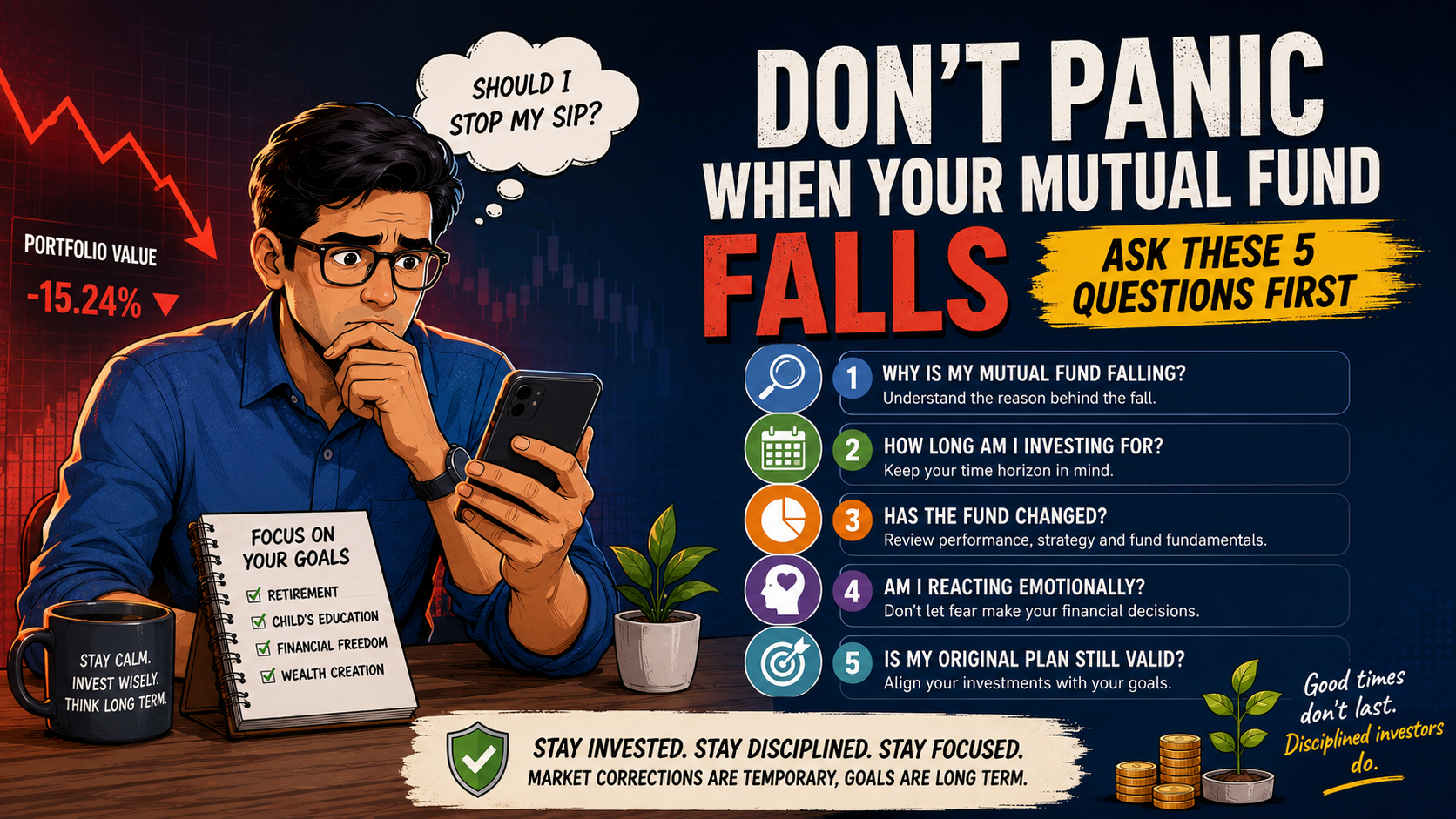
You open your investment app.
Your mutual fund portfolio is down.
The number is red.
Maybe it’s down 5%. Maybe 10%. Maybe even 15%.
And suddenly, the thought comes:
“Should I stop my SIP?”
If you have ever felt this way, you are not alone.
As a mutual fund distributor, I have seen how quickly investor confidence can change when markets fall. When the market is rising, investing feels easy. But when the portfolio turns red, even a long-term investor can start questioning the entire investment plan.
Before you press “Stop SIP” or redeem your mutual fund, take a breath.
A falling mutual fund does not automatically mean you have made a bad investment.
Sometimes, it simply means you are experiencing a normal part of equity investing.
The important thing is to understand why the investment is falling before deciding what to do.
Here are the 5 questions I would ask first.
1. Why is my mutual fund falling?
This is the first question – and perhaps the most important one.
Don’t start with:
“How much have I lost?”
Start with:
“Why has it fallen?”
Equity mutual funds invest in the stock market, and stock prices don’t move in a straight line.
Markets can fall because of:
- Global economic concerns
- Interest-rate changes
- Inflation
- Geopolitical events
- Corporate earnings concerns
- Changes in investor sentiment
- Market valuations
- Domestic economic developments
Sometimes the entire market falls.
Sometimes a particular sector falls.
Sometimes a particular fund underperforms its category or benchmark.
These situations are not necessarily the same.
A market correction and a bad investment are two different things.
If the broader market is down and your fund has also declined broadly in line with its category or benchmark, that may simply be market volatility.
But if your fund has been consistently underperforming comparable funds and its benchmark over a meaningful period, that’s worth investigating.
Don’t judge the fund before understanding the reason behind the fall.
2. How long am I investing for?
This question changes everything.
Imagine two investors.
Investor A needs the money six months from now.
Investor B is investing for retirement 20 years from now.
Both see their equity mutual fund fall 10%.
Should they react in exactly the same way?
Obviously not.
The first investor has a very different problem because the money may be needed soon.
The second investor has considerably more time to ride through market cycles.
This is why investment horizon matters.
If you are investing in equity mutual funds for a long-term goal, you should expect periods of volatility.
There will be rallies.
There will be corrections.
There will be periods when markets move sideways.
And there will be times when your portfolio temporarily loses value.
That’s part of the journey.
A long-term investment should not be judged solely by a short-term market movement.
3. Has the fund actually changed – or has the market changed?
This is where a proper review becomes important.
Suppose your mutual fund is down 12%.
That number alone doesn’t tell you whether you should stay invested.
You need context.
Ask:
How has the fund performed compared with its benchmark?
How has it performed compared with similar funds?
Has the fund’s investment strategy changed?
Has the portfolio changed significantly?
Has there been a change in fund management?
Is the fund still appropriate for my financial goal and risk profile?
These questions are much more useful than simply looking at the red number on your investment app.
Remember:
A falling NAV is not automatically a reason to exit.
But persistent underperformance or a fundamental change in the investment can be a reason to review.
4. Am I reacting to the market – or to my emotions?
This is probably the hardest question.
Because investing isn’t only about numbers.
It’s also about behaviour.
When your portfolio is up 20%, you feel confident.
When it falls 15%, suddenly you start doubting everything.
That’s normal human behaviour.
But successful investing requires us to recognise the difference between risk and fear.
Ask yourself:
“If I had not checked my portfolio today, would I still believe my investment plan was wrong?”
That’s an interesting question.
Sometimes the portfolio hasn’t changed fundamentally.
Our emotions have.
This is also why checking your mutual fund portfolio every day can be counterproductive for a long-term investor.
If your goal is 15 years away, today’s market movement is only one small part of the journey.
5. Am I still investing according to my original plan?
This is the question that brings everything together.
When you started investing, you probably had a reason.
Maybe it was:
- Retirement
- Children’s education
- Buying a home
- Financial independence
- Creating a long-term corpus
You also had a time horizon.
You decided how much you could invest.
You chose an investment approach based on your risk tolerance.
Now ask yourself:
Has anything actually changed?
If your goal is still the same…
Your time horizon is still long…
Your financial situation hasn’t changed…
And your investment remains suitable…
then a temporary market correction may not require a drastic decision.
But if your circumstances have changed, your investment plan may need to change too.
That’s when a proper review makes sense.
What about your SIP when the market falls?
This is where things get interesting.
Suppose you’re investing ₹10,000 every month through a SIP.
The market falls.
Your portfolio value comes down.
It is natural to feel uncomfortable.
But remember what your SIP is doing.
When prices are lower, your ₹10,000 can buy more units than it could when prices were higher.
This doesn’t mean a falling market guarantees future profits.
It doesn’t.
Markets can fall further, and mutual fund investments carry market risk.
But for a suitable long-term investment, continuing your SIP through different market conditions can help you maintain investment discipline instead of trying to predict exactly when the market will rise or fall.
The biggest mistake can be stopping because the market has become uncomfortable.
Should you ever stop a SIP?
Of course.
A SIP isn’t a commitment that you can never change.
You may need to stop or modify it if:
- Your financial circumstances have changed
- You need the money for an important goal
- Your risk tolerance has changed
- Your investment horizon has shortened
- Your asset allocation is no longer appropriate
- The fund no longer fits your investment objective
- Your financial priorities have changed
The point isn’t “Never stop your SIP.”
The point is:
“Don’t stop your SIP simply because the market is temporarily down.“
Make the decision based on your financial plan, not just the colour of the number on your screen.
Don’t make this common mistake
One of the biggest mistakes investors make during a market correction is switching from one fund to another simply because another fund is currently performing better.
You see:
Your fund: -8%
Another fund:
+2%
And you think:
“I should have invested there.”
But investment performance changes.
Today’s winner can become tomorrow’s laggard.
Instead of chasing recent returns, focus on whether the investment is appropriate for your objective, risk profile and time horizon.
Consistency is often more valuable than constantly chasing the latest winner.
A falling market can teach you something important
Market corrections aren’t pleasant.
But they can reveal something useful:
How much risk can you actually handle?
You may have thought you were comfortable with equity when markets were rising.
Then the market falls 15%, and you realise that you are losing sleep over your portfolio.
That’s valuable information.
Perhaps your portfolio is carrying more risk than you can emotionally and financially handle.
In that case, the answer may not be to abandon mutual funds altogether.
It may be to revisit your asset allocation.
A good financial plan isn’t one that looks perfect only when markets are rising.
It is one you can realistically stick with when markets become difficult.
Don’t forget the bigger financial picture
Your mutual fund portfolio is only one part of your financial life.
Before taking a major investment decision, also consider:
Do I have an emergency fund?
Do I have adequate health insurance?
Does my family have appropriate life insurance if they depend on my income?
Do I have high-cost debt that needs attention?
These things matter because financial security isn’t just about investment returns.
It’s also about being financially prepared for unexpected events.
SIP + HIP + TIP, wealth creation works better when it is supported by an appropriate protection and liquidity plan.
The 5-question checklist
So, the next time your mutual fund portfolio falls, don’t panic.
Ask yourself:
1. Why is my mutual fund falling?
Is it a broad market correction or something specific to the fund?
2. How long am I investing for?
Is this money needed soon or several years from now?
3. Has the fund changed, or has the market changed?
Look beyond the latest return.
4. Am I reacting emotionally?
Am I making a financial decision because I’m afraid?
5. Is my original investment plan still valid?
If your goals, time horizon and circumstances haven’t changed, don’t let short-term volatility automatically change your long-term plan.
The Bottom Line
A red number on your mutual fund statement can be uncomfortable.
I understand that.
But a falling mutual fund is not automatically a bad mutual fund.
The market will have good periods and bad periods.
Your portfolio will have good years and disappointing years.
That’s the reality of investing in equities.
The objective isn’t to avoid every correction.
The objective is to build a financial plan that matches your goals and risk profile and then have the discipline to follow it through different market cycles.
So the next time your mutual fund falls, don’t immediately ask:
“How much have I lost?”
Ask:
“Has something fundamentally changed, or am I simply experiencing a normal market cycle?”
That question can lead to a much better investment decision.
Stay informed. Review periodically. Don’t panic. And let your financial goals not market noise guide your decisions.
💬 What would you do?
If your mutual fund portfolio falls 15%, would you:
A. Stop your SIP
B. Continue investing
C. Review the fund first
Tell me your answer in the comments.
If you would like to discuss your mutual fund investments and how they fit into your financial goals, feel free to connect with me.
Also Read: Human Capital Theory & and Financial Risk
Disclaimer: Mutual Fund Investments are subject to market risks. Read all scheme-related documents carefully before investing. This article is for educational purposes only and should not be considered investment advice or a recommendation to invest in any particular mutual fund scheme. Past performance is not indicative of future returns. Please consider your financial goals, investment horizon, risk profile and asset allocation before making investment decisions.