


As a mutual fund distributor, I often meet investors who say:
“I want to invest for a long-term goal, but who will reduce my equity exposure when my goal gets closer?”
That is where the concept of a Life Cycle Fund becomes interesting.
The newly launched NFO Mirae Asset Life Cycle Fund 2056 is designed around a simple idea: “Take more growth-oriented exposure when the goal is far away and gradually reduce risk as the maturity year approaches.“
What is Mirae Asset Life Cycle Fund 2056 NFO?
It is an open-ended fund with a pre-determined maturity year of 2056 and a mandatory glide path for goal-based investing.
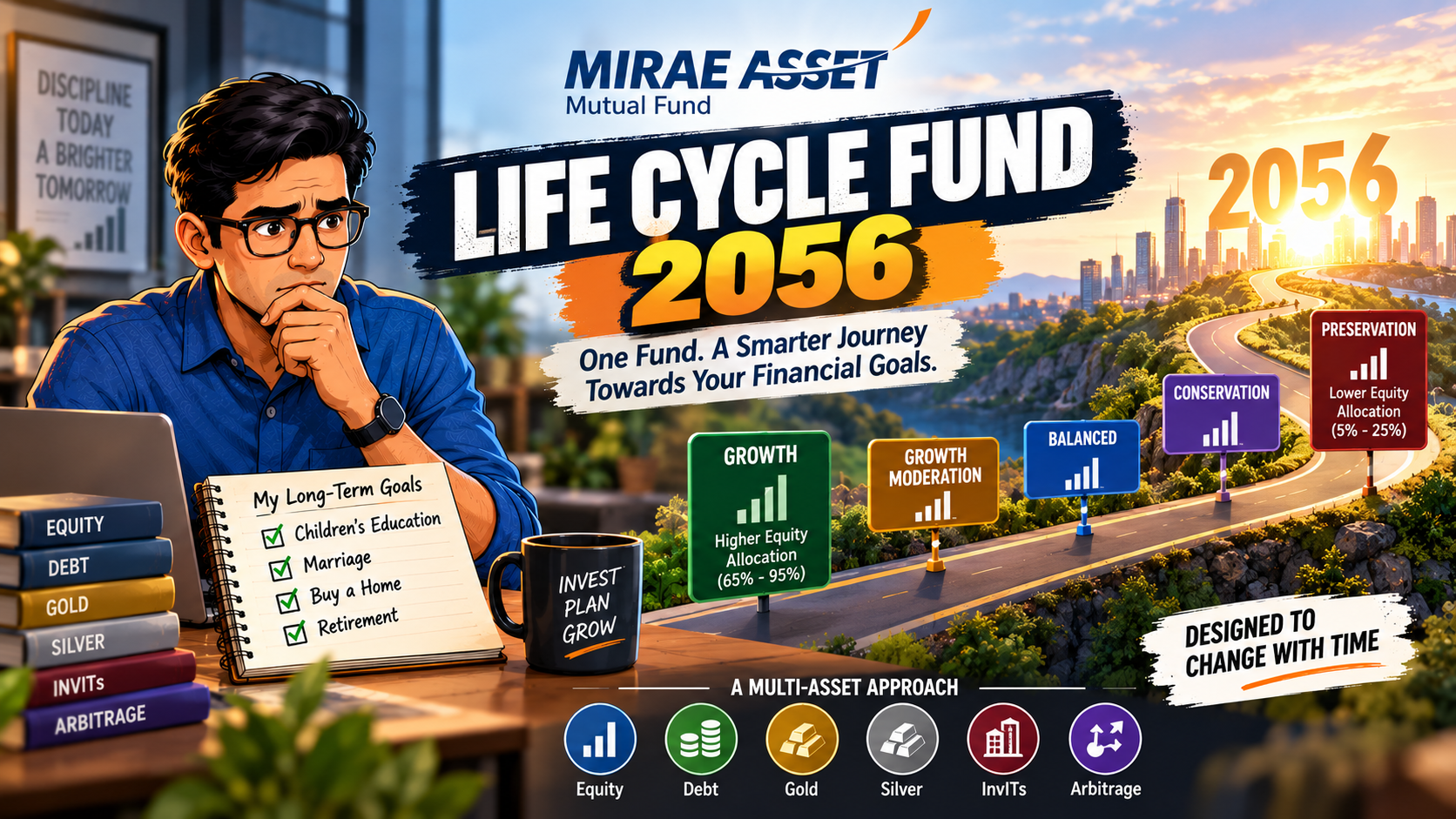
The fund follows a multi-asset approach. It can invest in equity and equity-related instruments, debt and money-market instruments, gold and silver, InvITs and arbitrage.
In simple words, this is not a fund where the asset allocation is expected to remain the same for the next 30 years.
The portfolio is designed to change with time.
The interesting part: the Glide Path
This is the feature that caught my attention as a distributor.
During the initial 15-year Growth phase, the fund’s net equity allocation is expected to be approximately 65%–95%.
As the fund moves towards 2056, equity exposure gradually comes down through different phases. Growth Moderation, Balanced, Conservation and finally Preservation.
In the final three years, net equity allocation is expected to be around 5%–25%.
So the basic philosophy is:
Long horizon → higher growth orientation
Goal approaching → gradually more conservative allocation
This can be useful for investors who don’t want to constantly monitor and rebalance their portfolio themselves.
It is not just an equity fund
Another interesting aspect is diversification across asset classes.
The scheme can invest in:
- Equity
- Debt and money-market instruments
- Gold
- Silver
- InvITs
- Arbitrage
Its benchmark is also a combination of NIFTY 500 TRI, NIFTY Short Duration Debt Index, Domestic Prices of Gold and Domestic Prices of Silver.
Within the equity portfolio, the allocation is also designed to change over time. The fund says it can move from roughly a 50:50 large-cap versus mid/small-cap mix in earlier years toward an approximately 80:20 mix as maturity approaches.
What about investment?
The NFO is open from 28 September 2026 to 12 October 2026, and the scheme is scheduled to reopen on 21 October 2026.
The minimum investment during the NFO is ₹5,000, while SIP is available from ₹99 per month.
There is also a graded exit load: 3% within one year, 2% between one and two years, 1% between two and three years, and nil after three years.
My distributor’s perspective
I see the biggest difference here not as “equity versus debt”, but as who manages the asset-allocation transition.
With a traditional equity fund, an investor may eventually have to decide when to shift some money towards safer assets.
With a life-cycle structure, that transition is built into the fund’s investment framework.
But that doesn’t mean it is suitable for every investor.
The 2056 maturity and long-term design are important considerations. Investors should first understand their own financial goal, investment horizon, risk capacity and liquidity requirements before considering such a product.
And one thing I would always remind investors:
Don’t invest just because a fund has an interesting concept. Understand the concept first, then see whether it fits your goal.
Final thought
Mirae Asset Life Cycle Fund 2056 brings a different approach to goal-based investing: invest for growth when you have time and gradually reduce risk as the destination gets closer.
For a long-term investor, the idea is certainly worth understanding. The real question is whether its 2056 horizon and predefined glide path match your own financial goal.
Also read: Invesco India Nifty Chemical Index Fund: Is India’s Chemical Story Worth Watching?
Disclaimer: Mutual Fund Investments are subject to market risks. Read all scheme-related documents carefully before investing. There is no assurance that the investment objective of the scheme will be achieved. The investment framework may change in accordance with the Scheme Information Document.