


When we think about India’s growth story, we usually talk about technology, banking, manufacturing or infrastructure.
But there is another industry quietly sitting behind many of these businesses –chemicals.
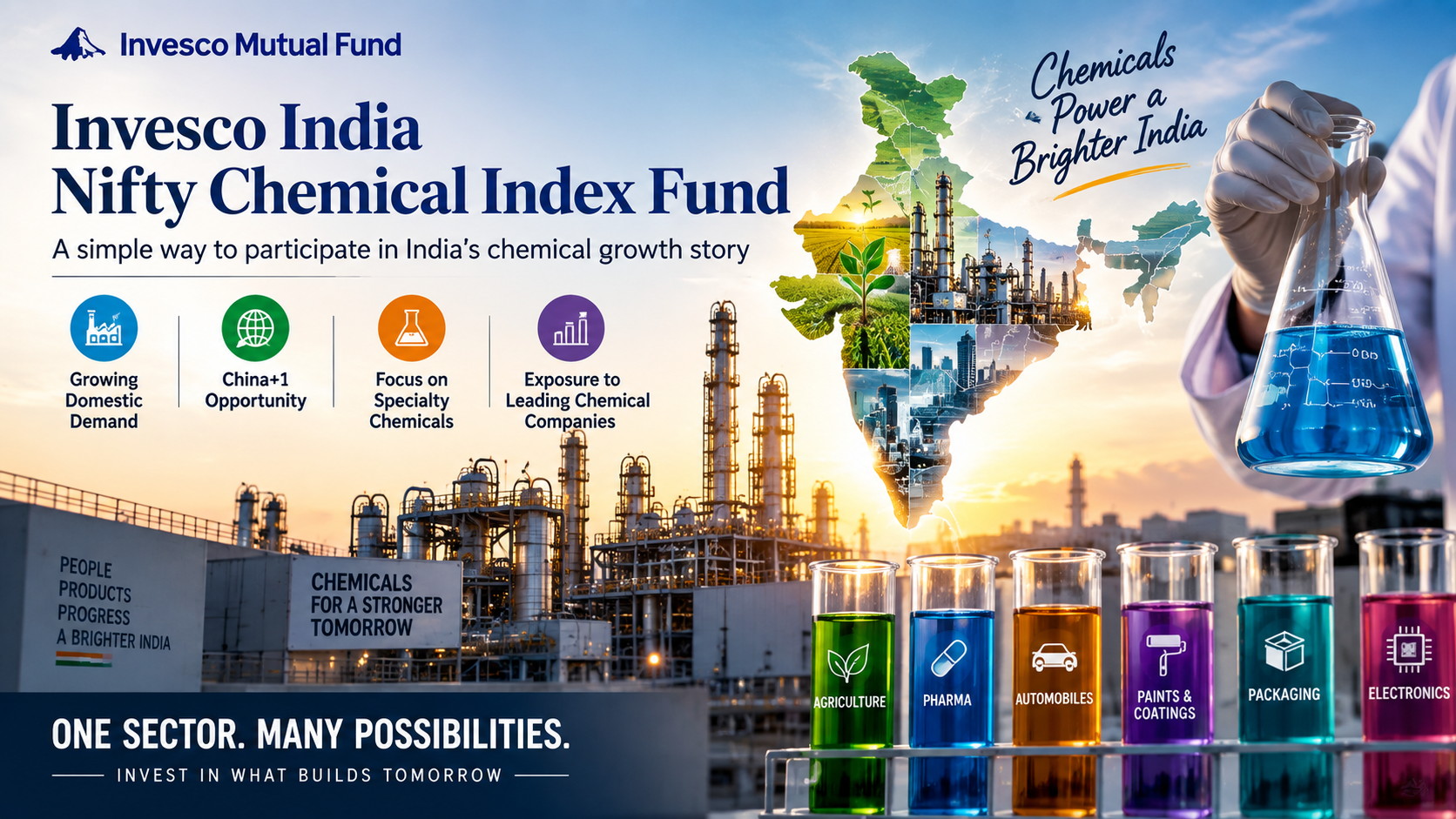
From pharmaceuticals and agriculture to automobiles, paints, packaging and electronics, chemicals are an important part of India’s economic and industrial ecosystem.
This is what makes the Invesco India Nifty Chemical Index Fund an interesting fund to understand.
It gives investors a passive way to participate in India’s chemical sector by tracking the Nifty Chemical Index.
So, let’s take a quick look.
Why is India’s chemical sector interesting?
There are a few important themes behind the sector.
Growing domestic demand
India’s chemical market has grown significantly over the years. The product presentation estimates the market could reach around $290–310 billion by FY30, compared with approximately $200–220 billion in FY25.
As India’s manufacturing, agriculture, infrastructure and consumption continue to develop, chemical demand can potentially benefit along the way.
The China+1 opportunity
Global companies are increasingly looking to diversify their supply chains.
India has been trying to capture a larger share of this opportunity, and the presentation highlights that Indian chemical exports grew at around 8% CAGR between FY15 and FY24.
More focus on specialty chemicals
The sector isn’t only about traditional chemicals anymore.
The presentation highlights opportunities in specialty chemicals, performance chemicals, electronic chemicals, battery materials and biopharma inputs.
That shift towards more specialised products is an important part of India’s chemical-sector story.
What does the Nifty Chemical Index actually contain?
The index consists of 20 companies from the chemical sector.
As of July 31, 2026, Specialty Chemicals accounted for 34.41% of the index, followed by Pesticides & Agrochemicals at 18.18% and Commodity Chemicals at 15.82%.
The index includes names such as Pidilite Industries, Solar Industries India, SRF, UPL, PI Industries, Coromandel International and Navin Fluorine International, among others.
So, instead of investing in just one chemical company, the index provides exposure to a basket of companies across different chemical segments.
What has the index delivered historically?
This is where things get interesting.
According to the presentation, ₹10,000 invested in the Nifty Chemical Index in April 2005 would have grown to approximately ₹4.34 lakh by July 2026.
The index’s historical CAGR since April 2005 was shown at 19.3%, compared with 13.7% for the Nifty 50 TRI over the same period.
But there’s an important second side to the story.
Higher historical returns have also come with higher volatility.
For example, the presentation shows that the Nifty Chemical Index’s 3-year rolling returns ranged from approximately -20.5% to 50.5% over the period analysed.
So this isn’t an investment theme where investors should expect a smooth journey.
What kind of fund is it?
The Invesco India Nifty Chemical Index Fund is a passive index fund.
Under normal circumstances, the scheme proposes to invest 95%–100% in equity and equity-related securities of the Nifty Chemical Index, with up to 5% in money-market and liquid instruments.
The scheme is classified as Very High Risk.
That’s an important point.
This is sector-focused equity exposure, not a substitute for a diversified equity mutual fund.
So, should you invest?
I wouldn’t start with that question.
I’d start with:
“Do I need exposure to the chemical sector in my portfolio?”
Then consider:
- Is my investment horizon long enough?
- Can I handle significant volatility?
- Am I already exposed to chemical companies through other mutual funds?
- Does this fit my overall asset allocation?
- Am I investing because I understand the sector, or simply because past returns look attractive?
These questions matter because a good sector story doesn’t automatically mean good returns at every valuation or during every market cycle.
The Bottom Line
India’s chemical sector has some compelling structural themes — rising domestic demand, specialty chemicals, exports and the China+1 opportunity.
The Invesco India Nifty Chemical Index Fund provides a simple, passive way to participate in that theme through a basket of chemical-sector companies.
But remember:
Opportunity and risk come together.
The fund is classified as Very High Risk, and historical performance should never be treated as a promise of future returns.
For me, the right way to look at this fund isn’t:
“Chemical sector is going to grow, so I should invest.”
It is:
“I understand the chemical-sector opportunity, I understand the risks, and this exposure fits my long-term financial plan.”
That’s a much better starting point for any investment decision.
Also Read:
Disclaimer: This article is for educational and informational purposes only and is based primarily on the Invesco Mutual Fund product presentation provided. It is not investment advice or a recommendation to invest in the Invesco India Nifty Chemical Index Fund. Past performance is not indicative of future returns. The scheme is classified as Very High Risk and does not guarantee returns or protection of capital. Mutual Fund investments are subject to market risks. Read all scheme-related documents carefully before investing.