


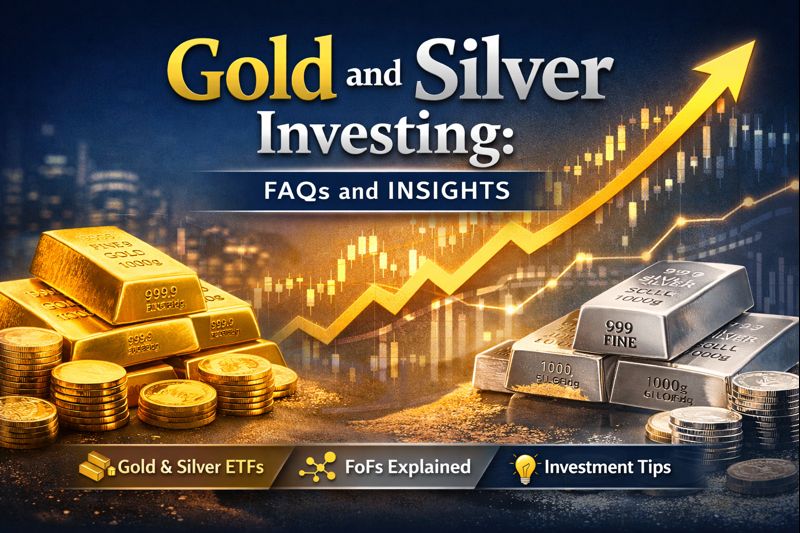
“Gold prices are at record highs… and experts expect them to rise further.”
You’ve probably heard this line recently during a casual conversation with friends or colleagues, at a family dinner, or in a WhatsApp group. Gold and silver have been making headlines again, and suddenly, precious metals are part of everyday conversations.
But from an investor’s point of view, the reactions are very different.
Experienced investors have seen such phases before. They understand market cycles, asset allocation, taxation, and timing. But many of the new investors are still unsure.
So let’s pause for a moment and simplify things.
Why Gold and Silver Matter in an Investment Portfolio
For us Indians, gold has never been just about returns. It’s an emotion. Almost every important moment in life has gold somewhere in the picture. A newborn’s first gift, a wedding ritual, an anniversary surprise, or saving quietly for a child’s marriage….Gold has always been part of our story.
Apart from tradition, gold and silver also play an important role during uncertain times. When inflation rises, geopolitical tensions increase, currencies fluctuate, or stock markets become volatile, investors naturally look for stability.
Precious metals offer a sense of safety and growth opportunities. Together, they help bring balance to an investment portfolio.
But buying gold and silver today isn’t the same as buying them 20 years ago. Nowadays, investors no longer need to worry about making charges, purity, storage, theft, or resale stress.
With Gold and Silver ETFs (Exchange Traded Funds) and Passive Mutual Funds (The mutual funds that invest in ETFs), precious metal investing has become simpler, cleaner, and more transparent.
What is a Gold / Silver ETF and a Gold / Silver FoF?
A Gold or Silver ETF is a market-linked investment that tracks the domestic price of gold or silver. When you invest in an ETF, you’re not buying jewellery or coins. Instead, you buy units that represent physical gold or silver stored safely by the fund. ETFs are traded on the stock exchange, just like shares, and require a Demat account. They offer a transparent and cost-efficient way to invest in precious metals without worrying about storage, purity, or safety.
A Gold / Silver Fund of Fund (FoF) works a little differently. It does not invest directly in physical metals. Instead, it invests in Gold ETFs and Silver ETFs. In simple words, it is a mutual fund that holds ETFs. This makes it easier for investors who don’t have a Demat account or who prefer a more hands-off approach. You can invest via SIP or lump sum, just like any other mutual fund, while the fund manages allocation and rebalancing.
Are Gold and Silver ETFs Backed by Physical Metals?
Yes, Gold and Silver ETFs are backed by physical metals.
Gold ETFs hold gold of 995 purity or higher, while Silver ETFs hold 999 purity silver. These metals are LBMA (London Bullion Market Association) certified and stored safely with approved custodians under strict regulations. In simple words, gold and silver exist physically in your portfolio, but you just don’t have to store or protect them yourself.
This gives investors exposure to precious metals without the physical burden.
Why Is the ETF Price Different from Jewellery Prices?
Jewellery prices include several additional costs, such as making charges, design premiums, jeweller margins, and GST. These costs can vary widely from one store to another.
ETFs, on the other hand, track domestic gold and silver prices, usually linked to MCX (Multi-Commodity Exchange of India Ltd.) futures prices. There are no making charges, no design premiums, and no GST on purchase.
So the difference isn’t about value, it’s about purpose.
Jewellery is meant to be worn. ETFs are meant to be invested.
ETF vs FoF: Which Option Is Better for Investment?
There’s no single right choice when it comes to choosing between ETFs and FoFs.
ETFs suit investors who already have a Demat account, like tracking their investments, and are comfortable managing their allocation themselves.
On the other hand, FOFs are better suited for those who want exposure to both metals through one product, prefer convenience, and do not want to worry about rebalancing or maintaining a Demat account.
The better option depends on how involved you want to be as an investor.
Can Investors Redeem in Physical Gold from ETFs?
Technically, yes, but practically, it’s not meant for most retail investors.
The Physical redemption from ETFs is allowed only under specific custodian conditions and above a very high threshold (around ₹25 crore).
P.S. Investors should treat ETFs as financial investments, not as a way to take physical delivery.
How Much Gold and Silver Should One Hold?
A commonly followed approach is to keep around 10–20% of the portfolio in gold and silver combined. This allocation helps with diversification, stability, and long-term balance, especially during volatile market phases.
The exact percentage should always depend on your financial goals and risk comfort.
Taxation on Gold and Silver ETFs and FoFs
The taxation on Gold and Silver ETFs is based on holding period, while Gold and Silver FoFs have a slightly longer holding requirement for long-term tax benefits:
Gold & Silver ETFs
- STCG (< 1 year): slab rate
- LTCG (≥ 1 year): 12.5%
Gold & Silver FoFs
- STCG (< 2 years): slab rate
- LTCG (≥ 2 years): 12.5%
Understanding Costs and Expense Ratio
Gold & Silver FoFs carry two layers of cost: the FoF expense and the underlying ETF expense.
Total Expense Ratio = FoF TER + Underlying ETF TER
For example, if an ETF charges 30bps and the FoF charges 10bps, the total cost becomes 40bps.
FoFs are slightly costlier than ETFs, but they offer convenience, automatic rebalancing, and simplicity.
Gold and Silver: Outlook and Portfolio Role
Both precious metals are in focus for different reasons.
Gold continues to receive strong support from central banks across the world, which have been increasing their gold reserves. Central banks prefer gold as a long-term store of value in uncertain economic and geopolitical conditions. This consistent institutional buying creates a strong demand base and keeps gold prices resilient, even during volatile market phases.
Silver, on the other hand, has been gaining attention due to growing industrial demand, particularly in sectors such as electric vehicles, renewable energy, and electronics. As the world moves towards cleaner energy and advanced technology, silver’s industrial use continues to expand. This demand adds growth potential, but also higher volatility.
Rather than choosing one over the other, investors may benefit from understanding their roles. Gold acts as a stabiliser, while silver adds a growth element. The right mix depends on your goals, time horizon, and comfort with market fluctuations.
Final Thought
Gold and silver investing is not about chasing headlines or predicting market highs and lows. It is about balance, protection, and long-term planning.
The real question isn’t when to invest, it’s how to invest correctly. And once you have clarity, everything becomes simple.
A Thought Before You Take the Next Step
If gold or silver is already on your mind, it’s worth pausing to ask one simple question: Does this fit my long-term financial goals?
The right decision isn’t about what’s popular, it’s about what’s right for your portfolio.
A short, honest discussion can help bring that clarity, whether it’s choosing between ETFs and FoFs, understanding allocation, or simply avoiding common mistakes.
Also Read: 👉 Human Capital Theory & Financial Risk: An Age-Based Perspective
Disclaimer: This article is for informational and educational purposes only and should not be considered as investment advice. The views expressed are based on general market understanding and publicly available information and may change with market conditions. Gold, silver, and related mutual fund investments are subject to market risks. Past performance is not indicative of future results