



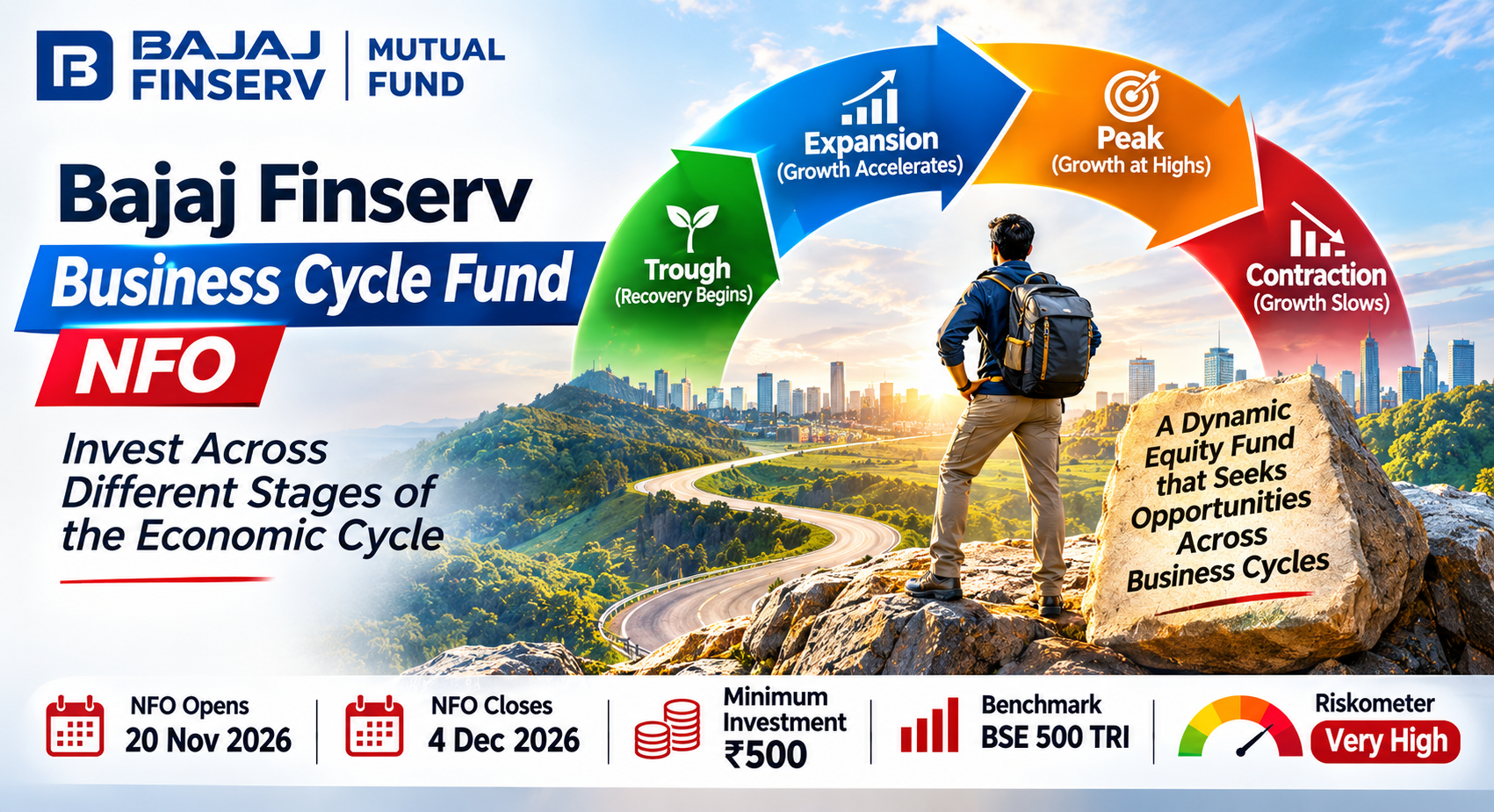
Every business goes through different phases. Some sectors grow rapidly during an economic expansion, while others perform better during a slowdown or recovery. Understanding these changing phases can help investors identify opportunities in the equity market.
With this approach, Bajaj Finserv Business Cycle Fund is coming with a strategy that focuses on investing across sectors and companies at different stages of their business cycles.
Let’s understand what this fund offers and what investors should consider before investing.
What is the Bajaj Finserv Business Cycle Fund?
It is an open-ended thematic equity fund that aims to generate long-term capital appreciation by investing in companies across different sectors and industries, depending on their business-cycle position.
The fund will actively adjust its sector and stock allocation as economic conditions change. Its investment process combines a top-down approach to identify promising sectors with bottom-up research to select individual companies.
How does the investment strategy work?
A typical business cycle has four phases:
- Expansion: Economic growth and business activity increase.
- Peak: Growth stabilises at a high level.
- Contraction: Economic activity slows down.
- Trough: Growth reaches a weak point before recovery.
Different industries may perform differently during these phases. The fund aims to identify sectors that could benefit from the prevailing economic environment and adjust its portfolio accordingly.
It will invest 80%–100% in equity and equity-related instruments of companies selected based on the business-cycle theme. The remaining allocation may include other permitted equity investments and liquid instruments.
Key NFO details
- NFO Opens: 20 November 2026
- NFO Closes: 4 December 2026
- NFO Price: ₹10 per unit
- Minimum Investment: ₹500
- Minimum SIP: ₹500, with at least 6 instalments
- Benchmark: BSE 500 TRI
- Equity Fund Managers: Sorbh Gupta and Bharat Hegde
- Exit Load: 1% if redeemed within 3 months; nil thereafter
- Riskometer: Very High
What are the potential advantages?
The strategy offers flexibility to move across sectors rather than remaining focused on a single industry. It can invest across large-, mid- and small-cap companies and seeks to identify opportunities arising from India’s structural growth trends and changing economic conditions.
However, successful business-cycle investing depends heavily on identifying the right opportunities and timing sector allocation decisions.
Risks investors should understand
This is a Very High Risk equity fund. Sector rotation decisions may not always work as expected, and economic cycles are difficult to predict accurately. The portfolio may also take concentrated exposure to selected companies or themes. Market volatility and stock-specific risks can affect returns.
My view as a mutual fund distributor
The Bajaj Finserv Business Cycle Fund may be worth evaluating for investors who understand thematic investing and have a long investment horizon with the ability to tolerate equity-market volatility.
I would consider such a fund as a satellite allocation rather than a replacement for a diversified core portfolio. Before investing, evaluate your financial goals, risk appetite and existing portfolio.
Click here to invest in the Bajaj Finserv Business Cycle Fund
Remember, identifying a business cycle is one thing; benefiting from it through investment decisions is another.
Also read: Nippon India CRISIL-IBX SDL June 2037 Index Fund: A Long-Term Debt Investment Opportunity
Disclaimer: Mutual Fund investments are subject to market risks. Please read all scheme-related documents carefully before investing. The scheme is rated Very High Risk. This article is for investor education and is not an investment recommendation.






[…] Also Read: Bajaj Finserv Business Cycle Fund: Can Investing with Business Cycles Create Long-Term We… […]